Friday, October 16, 2015

Wine Colored Days

So, Sicily.


Bellini Piazza in daylight
Arriving in Catania at night, we found ourselves on the fifth floor of a mouldering 300-year-old palazzo, where our room for the night was huge but smelled strongly of sulfur -- Phil claimed it was from Mt. Etna, which was not at all nearby. We set out for a beer in what we later learned was the Bellini Square, and found to our surprise that at 11 p.m. on a Sunday night, the city was just coming alive. Young and old -- and middle-aged with their small children -- strolled past dressed in finery ranging from bridge & tunnel jeggings and spike heels to Williamsburg shredded jeans and man-buns. It was quite a scene.

In the morning we headed for the duomo, dedicated to St. Agata -- a sumptuous baroque exterior with an enormous cupola. Across the street was another enormous
church also dedicated to St. Agata. A Sicilian saint and virgin martyr, she was imprisoned and tortured by having her breasts torn off with pincers. Then she was sentenced to be burned, but an earthquake saved her, and she spent the rest of her life in prison after being miraculously healed of her wounds by St. Peter. She is omnipresent in Sicilian ecclesiastical life.

In the center of the square was one of Phil's favorite things: a fountain featuring a black-lava elephant carved in Roman times, with an Egyptian column rising from its back, and saints and classical figures surrounding it - the symbol of the city, and a lesson in multiculturalism.


The fish merchants were kind
enough to give me their excess
ice for my poor feet, which gave
off the aroma of the sea for the
rest of the day.
We followed our noses to the open-air fish market, arranged around another fountain fed by an underground stream. We ate lunch beside the fish market after touring the Roman theater in the center of town, well-preserved but stripped of its original marble. We saw the exterior of the 15th century castle and the elegant buildings and courtyard of the university, the second oldest in Italy.

Later we revisited the Bellini Piazza (Bellini is a local son) and saw the floridly baroque opera house. We took a taxi to the airport to pick up our car, which I had again
specified should be an automatic. It turned out to be something called semi-automatic, which, much like the gun that shares its name, can be a weapon of death in the wrong hands (i.e. ours).

We had a GPS, which we decided to name Beatrice, but only if she was better at directing than
Nigel had been on Malta. Ninety minutes later (it was a 20-minute drive) we had renamed her B*tch. She wound us around and around various small towns, up and down the seacoast, until we were both nearly hysterical with frustration. Finally a kind gentleman in a local bar took pity on us and guided us in his own car up a hillside on a one-lane road to an unmarked driveway, where our hostess welcomed us at the most beautiful agriturismo we could ever have imagined. But you'll have to wait to see for yourselves.


Tuesday, October 13, 2015

Deeper Into Malta

We set out (late) in the morning for M'dina, a city walled by Arab conquerors containing perfectly preserved 17th century architecture -- the result of a rebuilding following one of Malta's many earthquakes. There were arguments with Nigel about the route; again we had to unplug him.

Because M'dina is so popular, we parked at the bottom of a hill (or mountain, depending on whom you ask) outside town and walked up and in, through a massive gate, along with many selfie-stick toting tourists. Our wanderings took us to the Duomo and its ecclesiastical museum. In the museum, there was an extraordinary display of Durer woodcuts and engravings -- several dozen at least. They were beautifully detailed, most on religious subjects.


We came across several weddings; apparently M'dina is a wedding destination. We also got to hear a marching band complete with accordion.


Then after lunch, we left to drive to the Dingli cliffs. As we found so often in Malta, traveling short distances -- in this case, three miles -- entailed innumerable roundabouts, missteps, and close

encounters on narrow roads. (Also, quite a bit of profanity.) Happily, the cliffs were splendid, dropping sheer to the sea from well over 100 meters, and rewarding us with glorious views on a perfectly clear day. However, this was the place where we learned why it is not a good idea to pick up a ripe prickly pear fruit from the ground and eat it. We are still picking the prickles out of our lips and tongues days later.

We'd been told by our hotelier in Kalkara that a festival would be occurring in the neighboring town of Burgu, and parking might be challenging. We got back in time to pull up in front of the hotel just as the crowds were descending for Burgu Day (or maybe some saint's day, we never did figure it out). It seemed to consist of every Maltese on the island walking up and down in the main street, in throngs, while vendors sold pastries, fried rabbit, and nougat and a local band played very bad versions of Adele and Mumford & Sons
songs. Candles were lit over the massive fortress that guards the town, and were displayed in every window. We were even able to have a night tour of the Inquisitor's Palace -- the Baroque palazzo where the Pope's envoy lived when he was sent to keep the naughty Knights of St. John in line.

We finished the night with octopus and raviolis across the harbor from the madness of Burgu, watching the fireworks and listening to the faint sounds of Adele's "Someone Like You" sung with a  Maltese accent.

Our final day in Malta took us to Hagar Qim, a mysterious archeological site on the other side of the island -- almost 20 miles (but at least an hour) away. The site includes two monolithic stone temples perched on the edge of the sea built around 3600 b.c.. by an unnamed and unknown group of Aboriginal Maltese (the same group who liked big butts, and I do not lie). The circular arrangement of both temples was constructed to take advantage of the solstice sun rays, as Stonehenge was at least 1500 years later. In addition to a museum, this national site featured an introductory 4-D video, including thunder, lightning, rain, and smell-o-rama.

Our next stop (and we did not, for once, get lost) was the Blue Lagoon a couple of miles down the road. It featurea two arching pillars of rock where the onrushing sea acquires a brilliant turquoise color as it washes against them.

What could bring our Maltese idyll to a more perfect conclusion than the national dish, long-deferred but now enjoyed? Rabbit -- sautéed with onions in white wine. One of us was very pleased. The other had rabbit and pasta, and gave most of the rabbit part to her husband.

On our way to the airport to fly to Sicily, we stopped at one of most
memorable sites in tiny Malta, and one of the most unspellable: Marsaxlokk, a fishing village whose harbor is filled with vividly painted boats that reflect the turquoise of the water in which they bob.

A strange, beautiful, slightly incomprehensible country.

Sunday, October 11, 2015

Island Hopping

Here we are in Malta!

Some things we didn't know about Malta that we now know:
1. They drive on the wrong side of the road. (An unpleasant surprise in the car rental parking lot, when Phil opened his door and the steering wheel wasn't there. We later learned that this was the result of being under British colonial rule for nearly 200 years.)
2. There IS a Maltese falcon. It's the rent the Knights of St. John paid to Holy Roman Emperor Charles V yearly for the island. One falcon.
3. It has prickly pears, which one should not pick up off the ground and eat unless one has a magnifying glass and tweezers to pick the prickles out of one's hand, lips, and tongue.
4. The language is totally weird. (Luckily for us, pretty much everyone speaks English.)

We took Ryanair from Luton Airport outside London. Ryanair has grown up; they now assign seats, there is no more triumphal music to celebrate surviving the flight. I kind of miss its scruffy chipperness. Now it's just an airline like any other, only the seats don't even pretend to recline. . Anyway, we arrived a little late in Valletta, the capital of Malta, named after Jean de Vallette. He was one of the Knights of the Order of St. John I mentioned in this post; Malta was where the Knights Hospitallier went after they were booted out of Jerusalem, Cyprus, and Rhodes. We were disturbed to find that our hotel was under construction, but the 8 a.m. jackhammers reminded us of London and helped us feel at home. (Also the view was gorgeous.)

Valletta is a beautiful city, all golden limestone, and we saw much of it on foot. The architecture is unified because the city was created out of nothing by the Knights in the 1540s (but much of it reconstructed after Malta was bombed heavily during WWII). Its crowning glory is the cathedral,
which is austere on the outside but almost absurdly dazzling inside, because the Knights of St. John ensured that every square inch of its cavernous interior would be covered with gold, frescoes, religious paintings, or inlaid marble. Each side chapel was dedicated by one of the eight chapters, or langues, from around Europe, and they compete with one another for splendor and opulence.

In the archeological museum, we read about the prehistory of Malta. The unnamed people who settled there had a liking for full-figured women;
all their sculptures are similarly endowed.

In the Grandmaster's Palace, which housed the leader of the Order of St. John, we viewed a plentitude of armor, weaponry, and historical artifacts pertaining to the siege of Malta -- the defining moment of the Knights' stay on the island -- when, in 1565, they turned back the Ottomans, led by Suleiman.

In the evening we picked up our car at the airport. I had very deliberately ordered an automatic shift, and we decided to add a GPS after our adventures getting lost and driving into trees in Mallorca. Our GPS, whom we named Nigel because he had a rather Oxbridge accent, did not quite know what to make of us (and vice versa). A typical car moment went like this:

NIGEL: Enter roundabout. Take third exit.
PHIL: What roundabout?
ME: There! Stay on your side of the road! You're too close on the left! I mean the right! Wait, take
this exit!
NIGEL: Take this exit. Take this exit.
PHIL: That was the second one! He said the third!
ME: Nigel's counting the entrances too! No, dammit, not that exit!
NIGEL: Make a U-turn at the first available instance, you pathetic wankers.

After a while, we were so lost that Nigel short-circuited and started to babble, "Turn right then left. Turn left then right. Turn right, then right, then bear right." We had to unplug him. An 8-mile drive from the airport to our beautiful hotel in Kalkara took us 45 minutes instead of 15. But the view of
the harbor from our room and the seafood pasta awaiting us were worth it.

More on Malta to come...

Wednesday, October 7, 2015

Phil Follows the Fleet

Not like that.


Nope, not like that either.


It went like this: Klauser's dear friend Cynthia -- now our friend as well -- invited Phil to follow the Fleet River, after which Fleet Street is named, from its source in Hampstead Heath to its mouth at the Thames. Theoretically this is a walk of about 6 miles, but almost all of the Fleet is now underground. It is a hidden river, so following it involves a certain amount of sleuthing, backtracking, and general lostness. Six miles is well outside my comfort zone, so I joined them for only the last mile or so. Here's their route:

The Pergola near Hampstead Heath
 (they got a little sidetracked)


A pond in Hampstead. Source of the Fleet? Probably not.


Garden near the Pergola
Saturday market in Kentish Town


Old alleyway with dog, Kentish Town

Canal fed by the Fleet

Beneath this manhole, the first sight and sound of the Fleet,
in the midst of a wedding party

Tree in St Pancras churchyard, where Thomas Hardy moved
coffins and headstones on the orders of his boss in the 1860s.
He claimed one of the excavated skeletons had two heads.

St  Pancras churchyard grave of William Godwin and
Mary Wollstonecraft

St Pancras church

Houseboats on canal at King's Place


Second hearing and sighting of the Fleet
as it rushes toward the Thames, in Clerkenwell


After I met the walkers at King's Place, we went to hear Cynthia's nephew Max Porter, author of the just-published and already-bestselling Grief Is the Thing with Feathers, speak on animals in literature. He was joined by philosophy professor Mark Rowlands, who has written a book about living with wolves (or wolf-dogs, really). Linking the two books was a bit of a stretch, but Max did so with grace and lucidity. We met him afterward and bought a copy of his book, which looks fascinating.


We capped off a week of walks and lectures by going to hear Klauser speak to a class at the British Film Institute on surrealism in film. He too was articulate and delightful, managing to link films as diverse as Le Chien Andaluse, Bimbo's Initiation (featuring an early Betty Boop, who at that point had dog ears!), and Being John Malkovich. The class was engaged and asked excellent questions; it was both informative and highly entertaining.


Our pub for the week (a short week, as we leave tomorrow for parts warmish and sunny):


The Bishop's Finger, with a special ale that
is only brewed on Fridays


The Bishop's special friend
 

Saturday, October 3, 2015

Old London Reinvented

In New York, if a theatre were ever to offer a performance lit only by candles, I'm pretty sure the FDNY would descend en masse and shut the thing down before the first players made it onstage. To our delight, though, that's not true in London.

We went with Klauser and Sue to Shakespeare's Globe Theatre, which was completely rebuilt using ancient materials and methods as a result of the American actor Sam Wanamaker's obsession. The New York Times explained,

"On [Wanamaker's] first visit to London in 1949, he had sought traces of the original theatre and was astonished to find only a blackened plaque on an unused brewery. He found this neglect inexplicable, and in 1970 launched the Shakespeare Globe Trust, later obtaining the building site and necessary permissions despite a hostile local council. He siphoned his earnings as actor and director into the project, undismayed by the scepticism of his British colleagues."
The Globe itself is open to the elements, but next door the Sam Wanamaker Playhouse, also a Renaissance replica, is enclosed and puts on plays year-round, so we saw Measure for Measure there. The stage was nearly bare, lighted by candelabras, and the performance was bawdily and brilliantly realized. (The downside was that the seating too was authentic; our backsides are all still in recovery.)

We continued our candlelit odyssey with a visit to the Dennis Severs house. Again joined by Sue and Klauser, with David also in tow, we booked a "silent
candlelight" tour. Severs was an artist who bought an 18th century house in central London and then fitted out various rooms to represent the way a silk weaver's family might have lived at different times in history. The only sounds were piped in noises of the century each room represents; the only light was candlelight. Each room was set up to look as if the family had just stepped out; one room even had a cat curled up on a bed. Sue, who is a museum curator, noted that as an art installation it was a remarkable feat. As history...well, in candlelight it was difficult to tell. Again, though, it was clear that this wouldn't be permitted in New York; visitors nearly caught their heads on fire from the hanging candelabras, and the rooms were as chock full of flammable objects as they could possibly be. It was both dangerous and fascinating.

To complete our experience of Old London, we hosted a tea for thirteen of Phil's students. I made two kinds of scones and four kinds of finger sandwiches, and Klauser came to demonstrate the art of making tea ("Warm the pot! Let the leaves breathe!"). The students were charming and appreciative -- only crumbs were left -- and Klauser's Victorian garb managed to help us forget the modern conveniences of electric kettle and (thank god) dishwasher.

Stretching the concept of Old/Candelit London a bit, we also indulged in a candlelight anniversary dinner at a marvelous French bistro in our neighborhood. And we took a lovely walk in  Kensington Gardens, described in the Other Blog, that culminated in my purchase of a cape for the cold weather. It manages to make me look almost exactly like Sherlock Holmes, lacking only the deerstalker and pipe, so I think it fits right in with the theme.


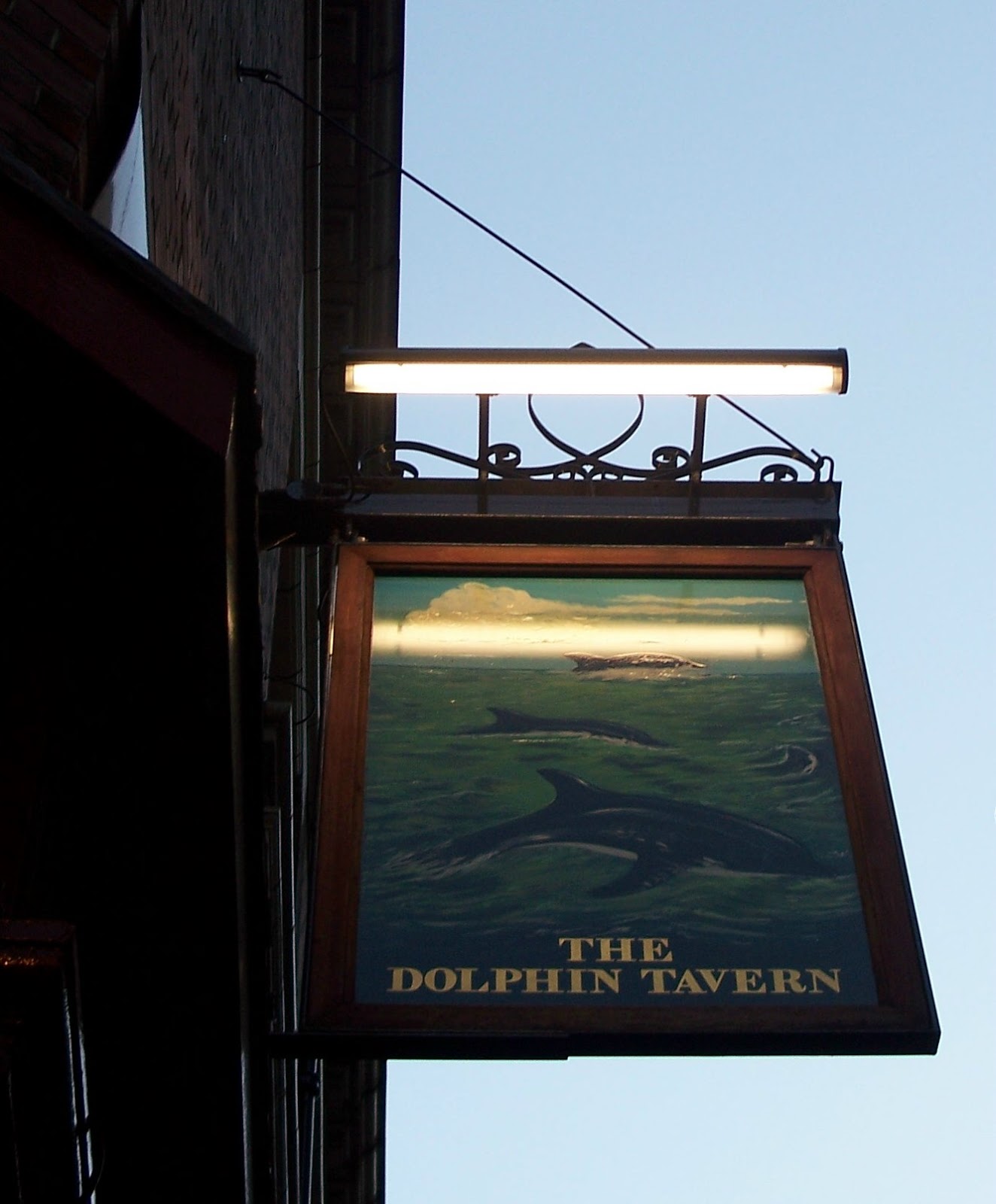
Our pubs for the week:
 

These two are across the street from each other.
Both have signs on the door:
"No overalls or work boots permitted!"
So we left our overalls at home.